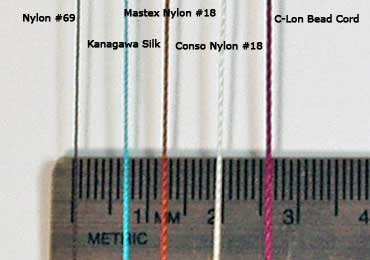
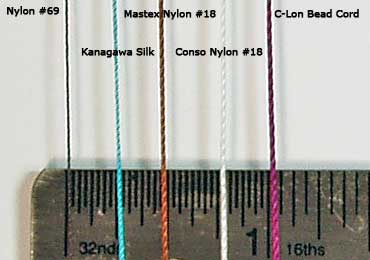
Dye Lot Drift - Each time a specific color is manufactured minute differences occur. The color may vary a bit even though the same dye lot formula is used. The finishing or bonding process may also vary a bit, so one lot/batch of spools may have a slightly different hand or feel. When noticeable differences in dye lot or feel occur, it is annotated. The actual dye affect the thread itself as well. As a general rule darker colors have a heavier feel than lighter colors. The actual thickness of the thread is altered by the dye. White nylon thread for example is always a bit thinner and has a lighter hand than colored nylon thread as it does not have any molecules of dyes attached to the molecules of nylon.
#18 Confusion - Many different type of thread have the number 18 in their name. Thread terminology is often confusing, do not confuse this thread with Nylon Seine Twine Size 18 or #18 Nylon Seine Twine, a cord much thicker usually available only in white or bright yellow or Nylon Crochet Thread Size 18 used for purses mostly. If you are looking for Nylon Crochet Thread, two companies make this thread, Omega Hilo and JP Coats. JP Coats is only available in a few colors. The Hilo Omega La Espiga Nylon Crochet Thread comes in a wide variety of colors and many sizes. The best online source for this product is Crochet Style ETC in Columbus Ohio at
http://creativeyarnsource.com/
C-Lon Bead Cord (Tex 210) - The breaking strength is ~ 34 lbs. Thread diameter is less than 0.5mm (0.5 millimeter = 0.019 685 039 inch = 1.26/64th of an inch). It fits easily one time through the holes of standard 4mm gemstone beads and Miyuki 11/0 seed beads. Doubled with a beeswax self-needle it passes through most 6mm gemstone beads, but only through some of the 4mm and the doubled thread on a split-eye needle passes easily through Miyuki 8/0s. > Bead Sizes for C-Lon
Each bobbin/spool is ~ 1 1/8 inches in diameter and 1 5/8 inches tall and holds ~ 92 yards. (Metric: bobbin diameter = 28mm, height = 40mm, ~ 84 meters of thread per bobbin.) Made in the USA.
About C-Lon Bead Cord Curling Up - When unwinding the thread, give it a pull one arm's length at a time and guess what: no more curls and the cord is pre-stetched - or use a warm iron to remove the curls. For more > Blog
C-Lon Micro Cord - Thin beading cord from C-Lon similar to Nylon #69. Breaking strength 11lbs, ~ 0.29mm thick. Use for detailed micro macrame, stringing with small-hole beads, crochet with 11s and 15s. Available in 32 colors. Economical packaging when compared with other beading thread per yard!
C-Lon Fine Weight Cord Tex 135 - This is the newer size of C-Lon Bead Cord, in between the Micro Size and the standard size. Introduced in February 2010. Breaking strength 24lbs, ~ 0.4mm thick. Use for detailed micro macrame, stringing with small-hole beads, crochet with 8s and 11s. Available in 24 colors.
C-Lon Tex 400 Beading Cord - Heavyweight beading cord. 48 colors. Introduced in May 2008. Colors matches C-Lon Bead Cord colors. Diameter ~ 9mm, just a breath under 1mm with my calipers. It is thicker than the Tuff Bead Cord Size 7 and in between the Omega Nylon Crochet size #5 and #6. Breaking strength ~ 75 lb. With a self needle, it fits through 4mm gemstone beads, Miyuki 8/0s once and passes twice through Miyuki 6/0s.
About Superlon or S-Lon Mac/Bead Cord - C-Lon is the original line. S-Lon/Superlon Mac/Bead Cord appears to be an exact copy or the same product, packaged in smaller, shorter and wider spools (77 yards versus 86-92 yards). For more on this > Read blog entry
D&E/Mastex - Genuine D&E/Mastex Nylon #18 is back in production once again under a different company D&E (as of March 2009). Mastex is out of business. Made in the USA.
Beadsmith Nylon #18 -The Beadsmith Nylon #18 was produced when Mastex went out of production for the first time in 2005. It has a heavier hand and it is more slippery, so harder to work with. Currently only Black & White are manufactured. Imported.
Conso - No longer manufactured. Was one of the oldest American company producing Bonded Nylon #18, originally manufactured in the USA, then overseas, then brought back to the USA.
Kanagawa 1000 Denier Embroidery Silk & Fujix Tire Silk - Filament silk, not spun silk, so the fibers are strong and do not shed. They have a lovely feel and sheen. The filaments are sturdy and well plied. They handle manipulation well unlike many other filament or spun silk. Great color range with the two brands combined!
Personal Notes
I have been using Nylon #18, Nylon #69, the Kanagawa Silks, Satin Cords and many of the thread currently sold in this online store for over 28 years. My personal supplies include the C-Lon Bead & Micro Cord lines, D&E/Mastex, Beadsmith, Conso, Tuff Bead Cord in Size 1 and 5, and my 'museum or vintage colors': nylon #18 no longer produced and manufactured, such as Robinson, Macrawold and discontinued colors by Conso and Mastex. I intermix them, use them individually and in combination. Color is usually my first criterion when choosing a thread, but quality is also an issue as different brands have different quality better suited for some specific uses. At one point I considered dyeing colors myself, but in order to get a good quality permanent dye, harmful chemicals need to be used, better suited for industrial settings. In October 2005 when I found the C-Lon line and got so excited with the new bright colors, 32 colors at that time. Imagine 3 purples, a chartreuse, lots of different pinks and a color line growing from 32 to 58 and now to 88 colors, and soon 116. Wow, what fun!
C-Lon Micro Cord and Nylon #69 - I use nylon #69/C-Lon Micro Cord in conjunction with nylon #18. It is great for stitching, wrapping, finishing and hidden construction. I also occasionally use it to do part of a one of a kind piece, such as the micro-knotting of a mini cabochon for a very small gemstone with need of a very high count of knots per square inch. It is also a great thread for beading fine beads with small holes such as many of the semi-precious and precious faceted beads out on the market right now. Many of my customers use this thread for bead crochet and bead loom weaving. One of my customers made several wallets with beaded panels woven on a loom with nylon #69 about 15 years ago. Her wallets have been in use everyday for over 15 years with no sign of wear!
Griffin Silk & Nylon - More about these products can be found here: Posts on Griffin